Straight Line Geometry and Perpendicular Lines
Understanding Points and Distances
Section titled “Understanding Points and Distances”When you’re working with coordinate geometry, everything starts with understanding how to measure distances between points in a plane. Let’s say you have two points:
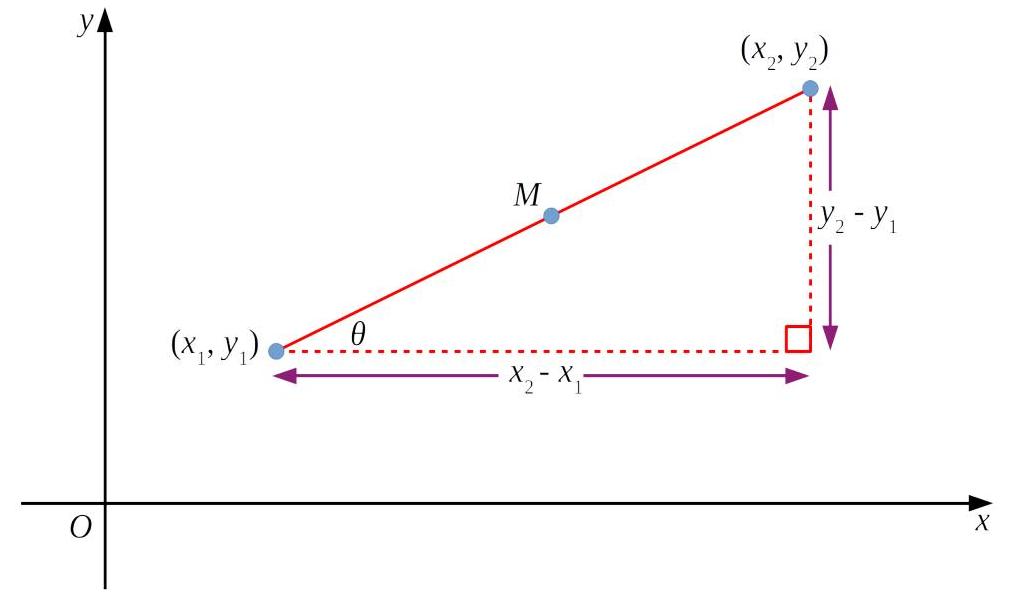
To find the straight-line distance between these points, think of it geometrically: you can move horizontally by
The distance
Or, taking the square root:
Click to flip • Press Space or Enter
Finding the Midpoint
Section titled “Finding the Midpoint”Sometimes you need to find the point exactly halfway between two points—that’s the midpoint. If you think about it logically, the midpoint should be at the average of the
For the
The same logic applies to the
That’s it—just the average of each coordinate! This formula works beautifully whether your coordinates are positive or negative.
Click to flip • Press Space or Enter
Understanding Gradient (Slope)
Section titled “Understanding Gradient (Slope)”The gradient tells you how steep a line is—how much the line goes up (or down) as you move horizontally. The steeper the line, the larger the gradient.
If a line passes through
We often call the vertical change
There’s another way to think about gradient: if the line makes an angle
This connects your coordinate geometry to trigonometry—handy when you’re solving more complex problems!
Finding the Gradient
Perpendicular Lines and the Negative Reciprocal
Section titled “Perpendicular Lines and the Negative Reciprocal”Here’s where things get really interesting. What happens when two lines are perpendicular (at right angles to each other)?
Imagine you have a line segment with gradient
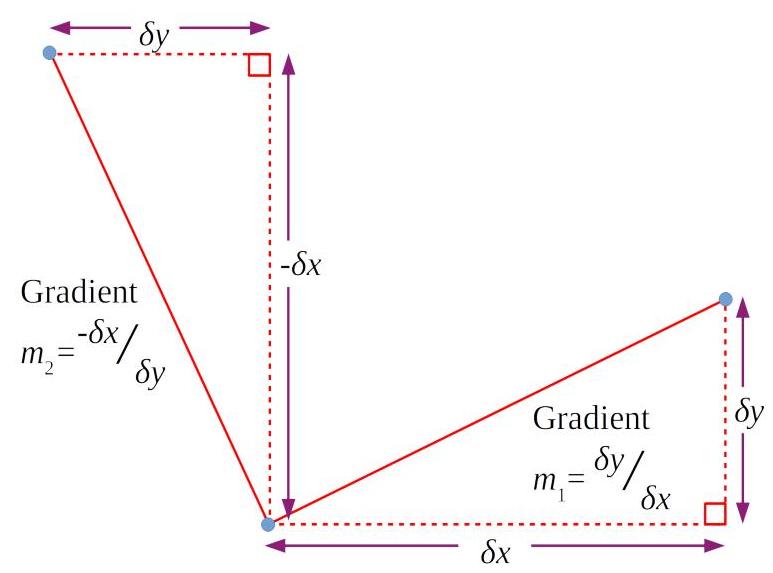
After the rotation, the new segment has gradient:
Notice what happened:
- The rise and run swapped places
- One of them got negated (changed sign)
The result is that the gradient of the perpendicular line is the negative reciprocal of the original gradient. This relationship is so important it has its own notation:
If two lines are perpendicular, their gradients multiply to give
The Perpendicular Line Relationship
- If a line has gradient
, the perpendicular line has gradient - Equivalently:
- The negative reciprocal property is THE key to perpendicular lines
- A line with gradient 2 is perpendicular to a line with gradient
- A line with gradient
is perpendicular to a line with gradient
Finding a Perpendicular Gradient
Perpendicular Lines with Fractions
Click to flip • Press Space or Enter
Putting It All Together
Section titled “Putting It All Together”Here’s a summary of the key formulas you’ve learned:
| Concept | Formula | What It Tells You |
|---|---|---|
| Distance | Straight-line distance between two points | |
| Midpoint | The point halfway between two points | |
| Gradient | The slope of a line (or | |
| Perpendicular | When two lines are at right angles |
Key Takeaways
- Distances between points come from Pythagoras’ theorem applied to horizontal and vertical distances
- Midpoints are just the averages of coordinates
- Gradient measures steepness and connects to both geometry and trigonometry
- Perpendicular lines have a special relationship: their gradients multiply to
- Always be careful with negative numbers—they’re a common source of mistakes!