The Equation of a Circle — Applications and Problems
Understanding the Circle Equation
Section titled “Understanding the Circle Equation”Circles are everywhere in mathematics and the real world. Whether you’re designing a circular track, analyzing planetary orbits, or solving geometry problems, you need a way to describe a circle algebraically. That’s where the equation of a circle comes in.
Let’s start with the basics. Imagine a circle with its center at the point
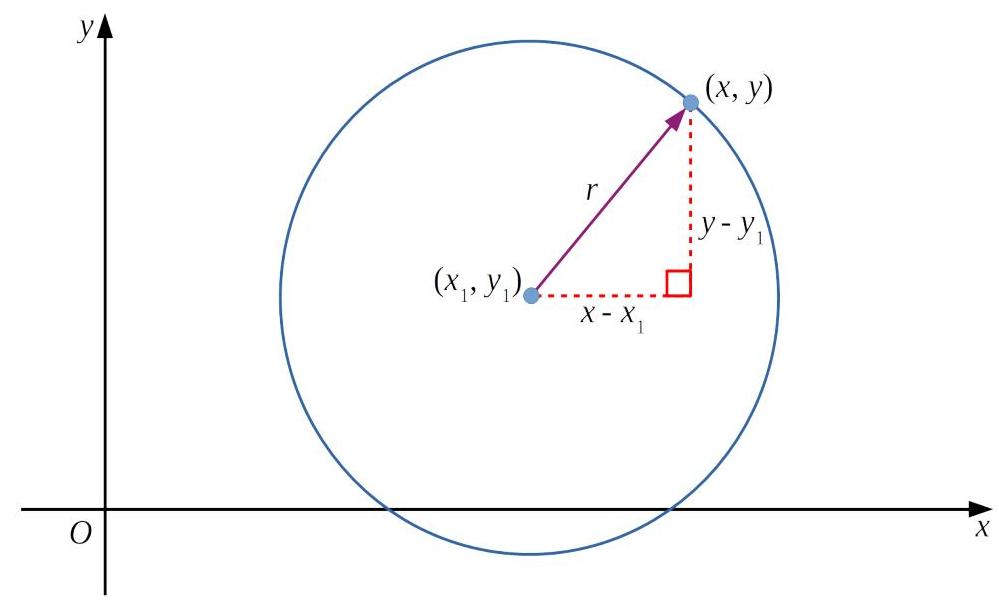
Now, consider any general point
This is the standard form of the circle equation. It beautifully captures the defining property of a circle: all points at distance
Circle Equation Essentials
- Standard form:
- Center:
is the center of the circle - Radius:
is the distance from center to any point on the circle - Geometric meaning: Every point on the circle is equidistant from the center
Working with General Form Equations
Section titled “Working with General Form Equations”Sometimes circle equations appear in a different form—expanded and rearranged. You might see something like
Example: From General to Standard Form
Section titled “Example: From General to Standard Form”Let’s work through a real problem. Consider the circle with equation
To find the center and radius, we complete the square for both
From this standard form, we can immediately read off:
- Center:
- Radius:
(since )
Click to flip • Press Space or Enter
Finding Tangent Lines to Circles
Section titled “Finding Tangent Lines to Circles”One of the most powerful applications of circle equations is finding tangent lines. A tangent line touches the circle at exactly one point and is perpendicular to the radius at that point of contact.
This perpendicularity is key! If you know the gradient of the radius, you can find the gradient of the tangent because perpendicular lines have gradients that multiply to give
Example: Finding a Tangent Line
Section titled “Example: Finding a Tangent Line”Let’s find the equation of the tangent to our circle
Step 1: Find the gradient of the radius from center to point of contact.
The center is at
Step 2: Use the perpendicularity condition.
Since the tangent is perpendicular to the radius, and perpendicular gradients multiply to
Step 3: Write the equation using point-slope form.
With gradient
So the tangent line is
Practice: Tangent Line
Find the equation of the tangent to the circle
Sketching Your Answer
Section titled “Sketching Your Answer”A practical tip: always draw a sketch to check if your answer makes sense! Your sketch should show:
- The circle with its center clearly marked
- The point of tangency on the circle
- The radius to that point
- The tangent line perpendicular to the radius
If your sketch shows a negative gradient for the tangent but your equation gives positive, something’s wrong. Sketching catches these errors quickly and builds your geometric intuition.
Further Exploration
Section titled “Further Exploration”There’s a whole world of circle problems waiting for you:
- Touching circles: How do two circles interact? When do they touch internally or externally?
- Pairs of circles: What happens when you have multiple circles? How do you find intersection points?
- Implicit circle equations: How can we work with circles defined in more complex algebraic forms?
Key Takeaways
- The equation
completely describes a circle using algebra - Complete the square to convert general form equations to standard form
- Tangent lines are perpendicular to the radius at the point of contact
- Always sketch your answer to verify it makes geometric sense
- Circle geometry connects beautiful mathematical principles with practical applications
Click to flip • Press Space or Enter