The Equation of a Straight Line (Derivation and Uses)
Finding the Equation of a Straight Line
Section titled “Finding the Equation of a Straight Line”The equation of a line is one of the most fundamental tools in coordinate geometry. Whether you’re analyzing a graph, solving a problem, or finding geometric relationships, knowing how to write and use the equation of a line is essential.
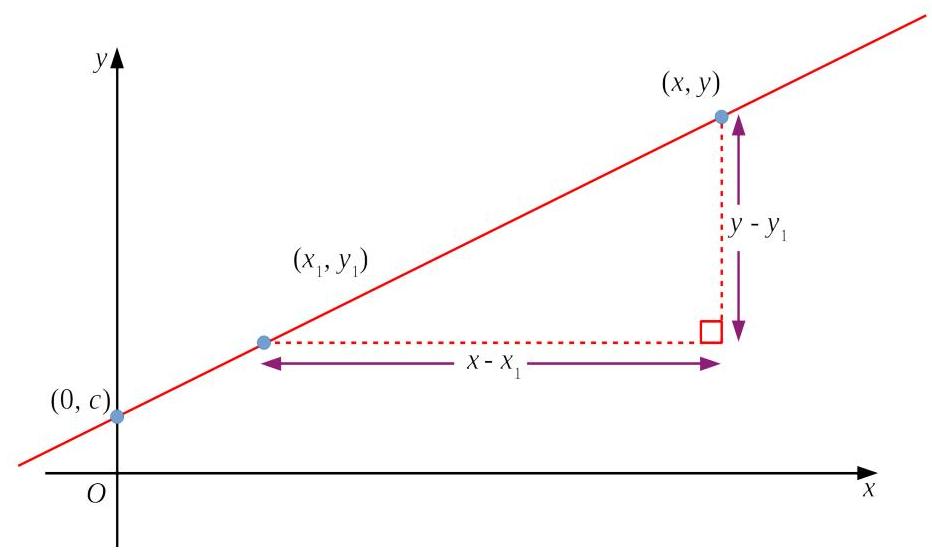
Let’s start with the core concept. Imagine a straight line with one fixed point
Rearranging this gives us:
Point-Gradient Form
- General form:
- What it means: Any point
on the line satisfies this equation - What we need: The gradient
and any point on the line
The Slope-Intercept Form
Section titled “The Slope-Intercept Form”This is probably the most familiar form. If we know the line passes through the
This tells us that
Finding the Equation from Two Points
Section titled “Finding the Equation from Two Points”Sometimes you don’t have the gradient—you just have two points the line passes through. No problem! You can:
- Calculate the gradient using:
- Use either point in the point-gradient form
Working Example: Finding the Circumcentre
Section titled “Working Example: Finding the Circumcentre”Let’s work through a complete problem that ties together everything we’ve learned. This is the kind of problem that shows why the equation of a line is so powerful.
Problem: A triangle has vertices at
- (i) Find the perpendicular bisectors of
and - (ii) Find where these two lines intersect
- (iii) Find the perpendicular bisector of
and verify all three meet at the same point
Strategy: Always sketch the three points roughly in the correct positions first. Your sketch helps you check if your answers make sense.
Part (i): Finding the Perpendicular Bisectors
Section titled “Part (i): Finding the Perpendicular Bisectors”For a perpendicular bisector, we need:
- The midpoint of the line segment
- A gradient perpendicular to the original segment (negative reciprocal)
Perpendicular bisector of AB:
- Midpoint of
and : - Gradient of
: - Perpendicular gradient:
(negative reciprocal of ) - Using point-gradient form with
:
Perpendicular bisector of BC:
- Midpoint of
and : - Gradient of
: - Perpendicular gradient:
(negative reciprocal of ) - Using point-gradient form with
:
Part (ii): Finding the Intersection
Section titled “Part (ii): Finding the Intersection”Now we solve these equations simultaneously to find where the two perpendicular bisectors meet:
The two perpendicular bisectors intersect at
Part (iii): Verifying the Third Bisector
Section titled “Part (iii): Verifying the Third Bisector”Let’s find the perpendicular bisector of
Perpendicular bisector of AC:
- Midpoint of
and : - Gradient of
: - Perpendicular gradient:
(negative reciprocal of ) - Using point-gradient form with
:
Verification: Substitute
Perfect! The point
The Circumcentre
- The three perpendicular bisectors of a triangle’s sides always meet at one point called the circumcentre
- You can draw a circle through all three vertices (the circumcircle) with the circumcentre as its center
- This elegant property shows how the line equations connect geometry in beautiful ways
Key Techniques to Remember
Section titled “Key Techniques to Remember”Click to flip • Press Space or Enter
Click to flip • Press Space or Enter
Click to flip • Press Space or Enter
Practice: Finding a Line Equation
A line passes through the points
Challenge: Perpendicular Bisector
Find the equation of the perpendicular bisector of the line segment from
Putting It All Together
Section titled “Putting It All Together”The equation of a line is far more than just a formula to memorize. It’s a bridge between algebra and geometry, allowing you to describe positions, relationships, and patterns. Whether you’re finding where two lines cross, constructing perpendicular bisectors, or analyzing geometric properties like the circumcentre, you’re using the same fundamental principles.
Master these forms and you’ll find coordinate geometry becomes much more intuitive:
- Point-gradient form (
) for when you know a point and the slope - Slope-intercept form (
) for when you know the intercepts and slope - Perpendicular relationships (gradient
perpendicular gradient = ) for geometric constructions
Now you’re ready to tackle more complex coordinate geometry problems!